Daraxonrasib doubles survival in metastatic patients and rewrites the story of pancreatic cancer treatment
A large international clinical trial has just delivered what many in the pancreatic cancer community have been waiting years for: a new treatment that significantly outperforms chemotherapy in patients whose cancer has already progressed on a first treatment. The results, published today in the New England Journal of Medicine and presented at ASCO, mark a genuine turning point for a disease where progress has been very slow.
What is Daraxonrasib and how does it work?
More than 90% of pancreatic cancers carry a mutation in a gene called KRAS. Think of it as a faulty switch stuck in the "on" position, constantly telling cancer cells to grow. For decades, scientists tried and failed to block this switch. Daraxonrasib from Revolution Medicines is a once-daily pill that, for the first time, successfully targets this mutation across its most common variants. It works differently from chemotherapy: rather than attacking all rapidly dividing cells indiscriminately, it goes after a specific molecular driver of the tumor.
The trial
500 patients across 59 centers in 6 countries, including two Italian institutions (Istituto Nazionale dei Tumori di Milano e l’Università di Pisa), have been enrolled in this study. All had metastatic pancreatic cancer that had progressed after a first round of chemotherapy, and the vast majority carried the KRAS mutation. Half received daraxonrasib daily; the other half received the available chemotherapy at their doctor's discretion.
The results
The difference between the two groups was striking, as shown in the chart below. Patients on daraxonrasib lived a median of 13.2 months, compared to 6.6 months on chemotherapy, double the survival. At the one-year mark, 53% of patients on daraxonrasib were still alive, versus only 19% on chemotherapy. The tumor shrank or responded to treatment in 33% of patients taking daraxonrasib, compared to 12% on chemotherapy. Patients also reported significantly less pain and better quality of life for longer.
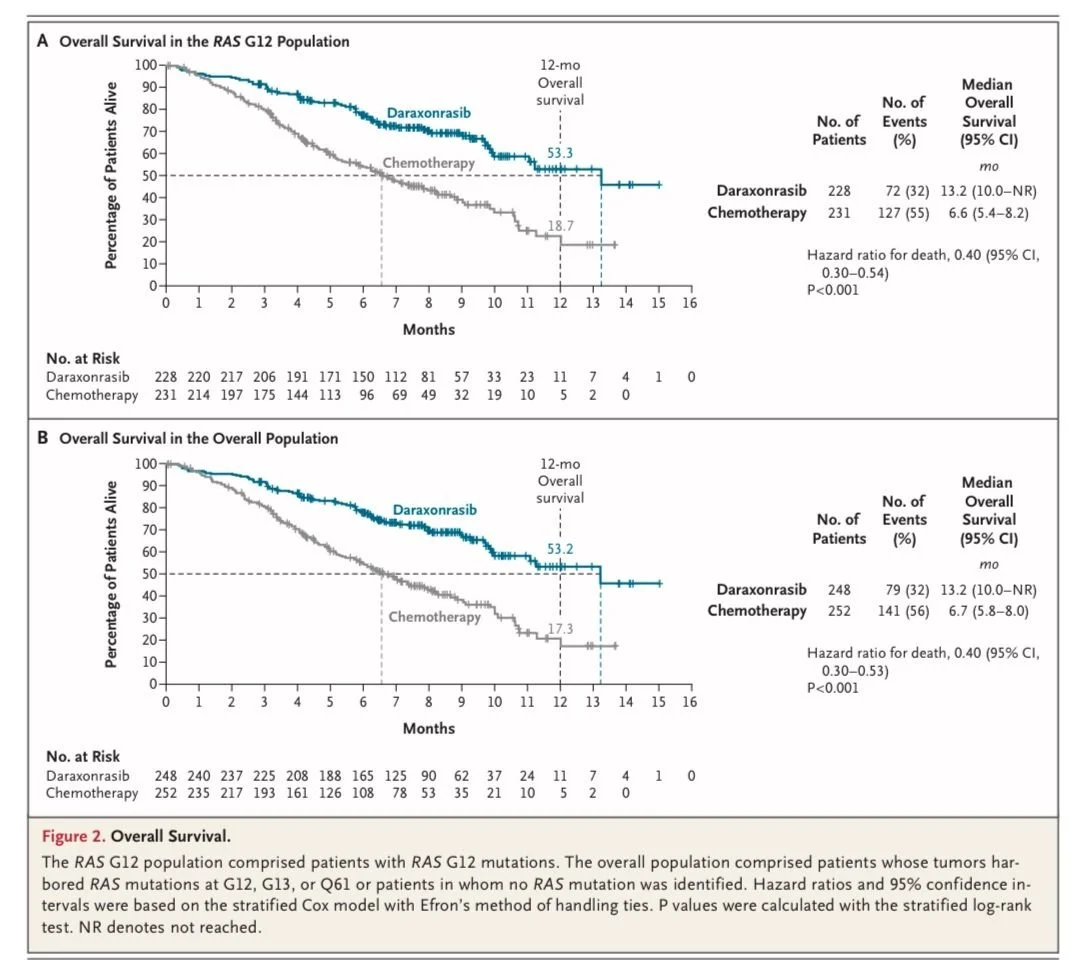
On the tolerability side, daraxonrasib was well-handled by the great majority of patients. Despite being taken for much longer than chemotherapy (6 months on average vs. 2–3 months), only 1.2% of patients had to stop treatment due to side effects, compared to 11.2% in the chemotherapy group. The most common side effects (skin rash, diarrhea, and mouth sores) were mostly mild to moderate and manageable.
Why this matters
To put these numbers in perspective: the survival achieved with daraxonrasib in second-line treatment actually compares favorably with what the best first-line chemotherapy regimens currently offer. This is a remarkable result for patients who have already been through one treatment.
What happens next
Daraxonrasib is not yet approved by the regulatory agencies. A month ago, the FDA has issued a “safe to proceed” letter allowing Revolution Medicines to initiate an expanded access treatment protocol (EAP) for the investigational drug Daraxonrasib. For patients in Italy and across Europe, access will depend on EMA approval followed by national reimbursement decisions.
Source: O’Reilly et al, NEJM 2026